
Background Score
How music shaped a childhood.

Music is almost always present in any life, even if only second hand. Debbie’s mother would hum quietly along to the radio as she dusted, swept the floors or sliced vegetables for the evening meal. Crooners like the dangerous Frank Sinatra, smooth talking Pat Boon catching a falling star and a jocular, overconfident Dean Martin were the background score to Deb’s childhood. For Debbie’s father, it was Glen Millar, and Louis Armstrong, but never Bing Crosby, and for her parents together, it was the Foxtrot, the Waltz, and the Pride of Erin. Deb, an only child, remembers going with her parents to the Balls in their local village; her mother willowy, delicate in a peach-coloured dress; her father in his suit, until someone announced, ‘gentlemen, you may remove your jackets.’ By that time, groggy with lemonade, cream puffs and the admiration of elderly, overdressed, damp skinned ladies, Deb, at the back of the hall where it was quiet, would be asleep on two chairs pushed together and covered with a blanket. Deb, likewise, was covered with her mother’s stole and one other offered by a kindly older lady ‘so the wee child doesn’t get cold.’
When Deb was older it was, for her, Elvis followed quickly by The Beatles, The Kinks, The Who, The Stones and Led Zeppelin, with their rush of melodies disguised as protests, of plaints, writ large, through impossible chord progressions. Here, on the dying edge of the 1950s, was the death of the waltz except in the memory of Deb’s parents, who failed to understand why Deb never really learned how to waltz.
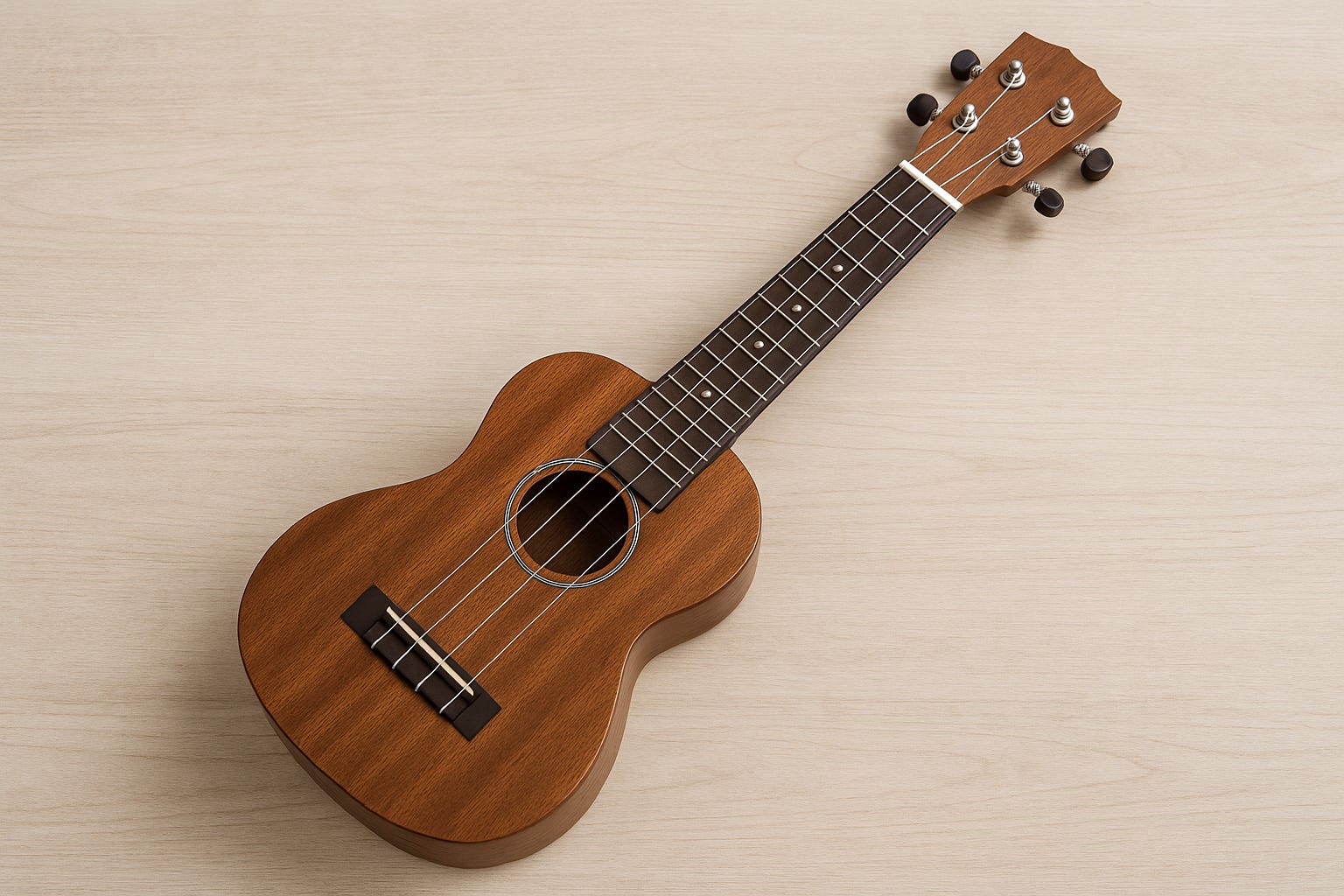
Deb decided, in her seventies, to learn the Ukelele. A pandemic helped; not in the assumed way – music to forestall the patina of death - but because Deb didn’t want to die having never learned to play any kind of instrument. A piano was out of the question – where would she put it? A guitar felt like more strings than she wanted to handle and a ukulele was congenially portable. After a year or two Deb realised all she learned from her Uke was an urge to know, so late in the span of a life, how it felt to play a song, even the simplest. In the process, Deb realised music itself was a metaphor …the rendering of mood, character, impression, and even sense in an undefinable counter language, a blessing of sound, a benediction of what, by any other medium, would be unutterable.
As always - a delightful read - thanks Janet.